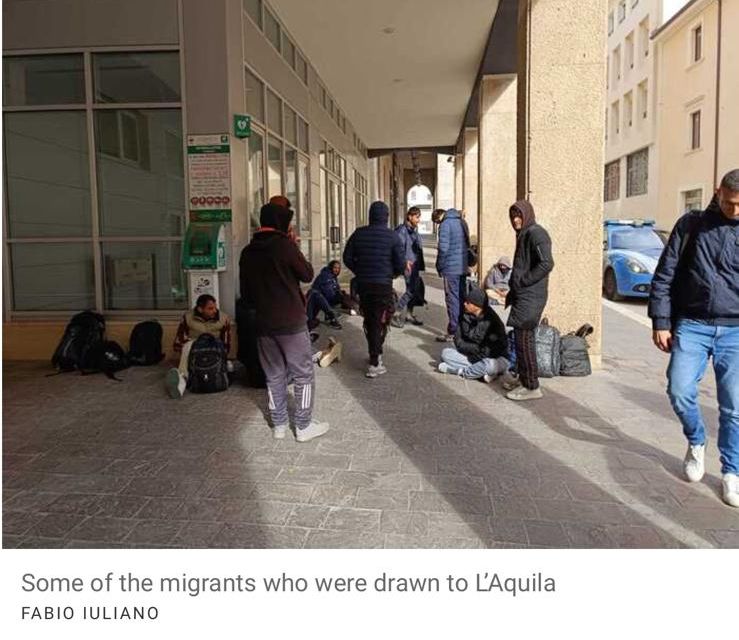
Not Lampedusa, not Rome, not Milan. L’Aquila is a mountain city still recovering from a devastating earthquake in 2009. It has few services for refugees and not many people. Yet in recent days, more than 70 migrants have arrived here, convinced they have found a promised land at the end of a dangerous journey across Europe from the Afghan-Pakistan border.
Many came because of a TikTok influencer. A young Afghan influencer on TikTok, known as Hayatkhan2.0, mentioned L’Aquila as a good place to live. Word spread quickly, showing how social media is reshaping migration routes.
A 19-year-old from Nangarhar province, who declined to give his name, said police took his fingerprints and later told him to leave when he asked for asylum at the prefecture: “Anywhere but not here.” He said he paid smugglers €13,000 to reach Europe after the Taliban killed two brothers accused of collaborating with American forces. With night temperatures near freezing, he and others have been sleeping in parks and parking lots.
At a charity soup kitchen a mile from the centre, migrants spoke about TikTok. Ismail Khojni, 36, who has been travelling for four years, said he had not seen the video but heard about it at a bus station in Rome and decided to come. Influencers speaking Pashto, the language of the Afghan-Pakistan border region, have proliferated, he said. “Everyone has opinions about which city allows migrants to get asylum more quickly,” he said. After eating a plate of pasta, some migrants watched a new video by Hayatkhan2.0, who said he was now in trouble with Italian police for directing dozens of people to L’Aquila.
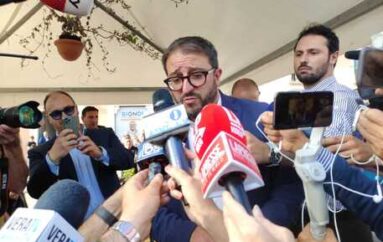
Mayor Pierluigi Biondi, of the right, said an investigation had been launched into the sudden influx. “This is not Lampedusa, we are in the mountains, so someone is behind this,” he said. Some migrants were transferred to a centre in Calabria, while another group was bused to a facility in Basilicata. Biondi said L’Aquila had previously welcomed Afghan refugees, but he said the city lacked the structures to host new arrivals. If word spread that L’Aquila was welcoming, “thousands would arrive in a few days,” he said.
The incident shows how social media is influencing migration, from smugglers advertising “Black Friday” deals for dinghy crossings to influencers shaping perceptions of where asylum is easiest to obtain.
Italy has recorded more than 61,000 arrivals in 2025, about 5 per cent more than the previous year, but far below the 147,000 registered over the same period in 2023. The issue has become a political flashpoint, with deputy prime minister Matteo Salvini calling for tougher measures at a campaign event alongside prime minister Giorgia Meloni.
In L’Aquila, local groups mobilised to help. A community organisation that runs exercise classes for the elderly collected 20 blankets for migrants. Paolo Giorgi, who runs the soup kitchen, said: “The city is good at these things. You ask for help and the city responds.” In the square, Ugo Tobia, a retired doctor, noted the irony of a region with more pensioners than working-age residents and reconstruction work needing labour. “Why don’t we give them a job?”