Italy: Small city becomes a destination for migrants via social media
The Italian city of L’Aquila has recently become a destination for migrants, fuelling political and social controversy. Many locals and officials argue that social media platforms such as TikTok are helping to spark interest in the town among a mostly young migrant community.
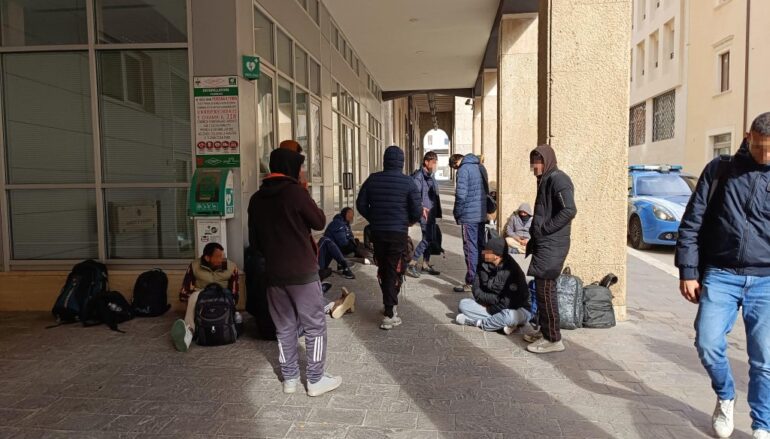
The arrivals gather outside government offices while the city is still asleep: the door is shut, the windows catch the first morning light, and the wheels of suitcases rattle on the pavement.
They queue in silence, as if someone might call their name. Some clutch a plastic bag; others stare at their phone screens. It is through those phones that many say they found the path to this mountain city in Abruzzo, in central-southern Italy.
No maps or institutional contacts sent them here, just messages and videos shared on social platforms like TikTok, where tips pass from one account to another until they turn into a physical destination: in this case, L’Aquila.
When the Prefecture opens and staff begin to enter, the migrants are already there. Many have spent hours on benches, bus-stop seats and other makeshift shelters, in the same area where, in recent weeks, other migrants have slept.
At one point, a group of 44 migrants who arrived in the town were later transferred to a prefecture in Calabria.
It appears that those reaching L’Aquila do not register at other formal shelters before arriving. Instead, they follow a route assembled on their phones, using screenshots and voice notes sent by migrants who travelled ahead of them.
It is a word-of-mouth system, an oral map running through the Balkan route. “I arrived a few days ago. I am 19, and I came on my own, on buses and trains,” says Maghdi, an Afghan student. On his phone he shows screenshots of money transfers from a relative: a few hundred euros at a time, enough to keep moving towards a place someone online described as a “useful destination”.
The group is made up mostly of people who travelled overland along the Balkan route. They come from several countries, including Afghanistan, Pakistan and Bangladesh. Nearly all are waiting to formalise a request for international protection.
“No one brought us here,” says another young man. “They advised us to come to L’Aquila.”
On his phone, he shows a video in Pashtu posted on TikTok. An influencer talks about documents, residency permits and opportunities in Italy. At a certain point, L’Aquila is mentioned.
In the comments, users ask for instructions: where to go, what to do once they arrive. Until a few weeks ago it seemed like an isolated episode, but it has started to resemble a new route.
The movement is fed not only by social media, but also by the word-of-mouth networks among migrants who pass tips to their peers. They share information about local support associations and the speed with which migration offices handle registration procedures. Smaller towns such as L’Aquila may have received fewer arrivals until recently and could initially process small groups more quickly, helping to spread the idea that applications might move faster in places like this mountain city, once internationally known for the devastating 2009 earthquake.
That thesis is disputed by L’Aquila’s mayor, Pierluigi Biondi, a member of Brothers of Italy, Giorgia Meloni’s party, which leads Italy’s governing coalition.
According to Biondi, the migrants were “sent to the prefecture by the usual profiteers who traffic human beings as if they were objects.”